Investing during periods of Geopolitical Uncertainty
March 3, 2026
We are writing to share our perspective on the recent escalation in the Middle East and its impact on global markets. Over the past several days, coordinated U.S. and Israeli military strikes on Iran and Iranian retaliation across the region, have disrupted Gulf energy flows, temporarily halted tanker traffic through the Strait of Hormuz, and rattled markets around the world.
We understand this kind of uncertainty can feel unsettling, and we want to provide you with context, perspective, and a clear-eyed path forward.
What’s Happening Now
The current conflict has sent ripples through several corners of the global markets. Oil prices have risen sharply, with Brent crude topping $84 per barrel—a gain of roughly 7% in a single day and the largest daily spike since March 2022. European natural gas prices have surged nearly 60% over the past two days, placing economic strain on the Eurozone. Global equity markets have also reacted: Asian benchmarks fell meaningfully overnight, with South Korea declining over 7%, Japan down 3%, and Hong Kong erasing its year-to-date gains. European equities posted their biggest two-day decline since April 2025.
In the U.S., Treasury yields have moved higher as inflation concerns resurface, with the 10-year yield back near 4.10%. Bond markets have pushed out Federal Reserve rate cut expectations, now pricing in only one full cut for 2026. Meanwhile, safe-haven assets such as gold and the U.S. dollar have strengthened—a typical response during periods of elevated geopolitical risk.
What History Tells Us
While headlines like these can feel alarming, decades of market data offer a reassuring pattern. Geopolitical shocks tend to produce short, sharp market reactions—not prolonged downturns.
Research examining more than 25 major geopolitical events since World War II shows that the S&P 500 has experienced an average decline of roughly 5% following these events, with markets typically reaching a bottom within about three weeks and fully recovering within approximately six weeks.
S&P 500 Performance Following Select Geopolitical Events
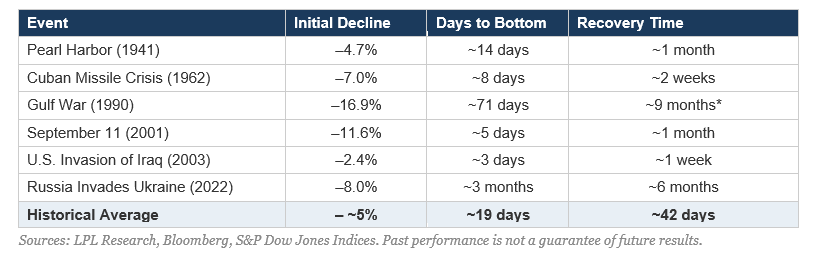
Consider a few notable examples: Following the September 11, 2001 attacks, U.S. markets were closed for several days; when trading resumed, the S&P 500 fell approximately 11.6%, yet recovered those losses within roughly one month. During the Cuban Missile Crisis of 1962, the index fell about 7% over several trading days, then recouped the losses in just over two weeks once the crisis de-escalated. Even the Gulf War in 1990, which coincided with a recession, saw markets recover within several months as uncertainty faded.
The key distinction is this: geopolitical drawdowns tend to be shorter and shallower than recessionary bear markets. When the underlying economy is healthy and corporate earnings remain resilient, historically, markets have processed these shocks quickly and moved higher. The sustained, multi-year declines that defined 2000–2002 or 2007–2009 were driven by structural economic weakness—bursting asset bubbles, financial crises, and recessions—not geopolitical events. Today, the U.S. economy continues to grow, corporate earnings are expected to accelerate in 2026, and the labor market remains solid.
Volatility Is Normal—And Was Expected
As we’ve communicated throughout the year, conditions were ripe for increased market volatility in 2026. Coming into this year, U.S. equity markets had posted three consecutive years of strong gains—a historically rare achievement. Valuations were elevated, with the S&P 500 trading at roughly 22 times forward earnings, a meaningful premium to the five-year average. And the last 10% correction occurred in April of 2025, nearly a year ago.
Statistically, the S&P 500 experiences a pullback of 10% or more about once every 18 months to two years on average. Corrections of 5-10% are even more routine, occurring multiple times in a typical year. There have been 84 such pullbacks since 1946. In other words, what we are experiencing is not unusual, it is a normal part of investing. This particular episode happens to have a geopolitical catalyst, but the underlying statistical case for a period of increased volatility was already present.
The Hidden Cost of Market Timing
When markets become volatile, the temptation to “step to the sidelines” can feel overwhelming. But decades of data show this instinct consistently works against investors. Research from J.P. Morgan Asset Management illustrates the point clearly: a $10,000 investment in the S&P 500 held over a 20-year period grew to roughly $65,000 when fully invested. Missing just the 10 best trading days over that same period cut the ending value to about $30,000, which is less than half. Missing the 20 best days reduced returns to roughly $19,000, and missing the 30 best days left the investor with only around $12,000.
Seven of the ten best trading days over the past two decades occurred within two weeks of the worst trading days. The biggest rebounds tend to happen when fear is at its peak—precisely when investors who have moved to the sidelines are most likely to miss them. The legendary fund manager Peter Lynch captured this dynamic succinctly when he noted that far more money has been lost by investors trying to anticipate corrections than has been lost in the corrections themselves.
The Value of Diversification
Moments like these are exactly why we build portfolios with diversification at the core. A well-constructed portfolio is designed to weather periods of turbulence by spreading risk across different asset classes, geographies, and sectors that tend to respond differently to the same events. During this current episode, for example, energy stocks and commodities have rallied, gold and the U.S. dollar have strengthened, and bond yields—while higher in the near term—remain well below their recent peaks, with the 10-year Treasury yield still under its late January high of 4.3%.
Research shows that a balanced, diversified portfolio has historically experienced only about 60% of the downside of a pure equity portfolio during major market declines. Over rolling five-year periods going back decades, a diversified mix of stocks and bonds has not produced a negative annualized return. Diversification does not eliminate risk, but it has consistently proven to be one of the most reliable tools for managing it.
Our Approach: Process Over Reaction
Our guidance remains the same as it has been throughout every period of market stress: stay invested, stay diversified, and stick to your plan. Your financial plan was built to account for periods exactly like this one—moments when uncertainty is high, headlines are unsettling, and the instinct to act feels urgent. The plan is the anchor.
We are closely monitoring developments across energy markets, global equities, fixed income, and the broader geopolitical landscape. If the conflict resolves in a matter of weeks and oil shipments through the Strait of Hormuz resume, history suggests markets will likely absorb this shock and move forward. Should the situation prove more prolonged, we are prepared to make thoughtful, incremental adjustments to positioning—not reactive shifts driven by fear.
Key Takeaways
- Geopolitical shocks have historically led to average S&P 500 declines of approximately 5%, with recoveries typically occurring within six weeks.
- Recessionary bear markets are driven by economic fundamentals, not geopolitical headlines. The current U.S. economy remains on solid footing.
- The S&P 500 had not experienced a 10% correction in nearly a year. Periods of volatility are statistically normal and were anticipated for 2026.
- Missing just the 10 best trading days over a 20-year period can cut portfolio returns by more than half. The best days tend to occur during the most volatile periods.
- Your diversified portfolio is designed for moments like this. Staying invested and sticking to your long-term plan remains the most effective strategy.
As always, please do not hesitate to reach out if you have questions or simply want to talk through what you are seeing in the markets. That is exactly what we are here for. In our experience, the most successful investors are not those who react fastest during periods of stress—they are the ones who stay disciplined and trust the process.
We appreciate your trust and confidence, and we remain committed to guiding you through every market environment.
Disclosures:
This communication is for informational purposes only and does not constitute investment advice, a solicitation, or a recommendation to buy or sell any security. The information contained herein is based on sources believed to be reliable but is not guaranteed as to accuracy or completeness. Past performance is not indicative of future results. All investing involves risk, including the possible loss of principal. Diversification and asset allocation do not ensure a profit or guarantee against loss. Indexes are unmanaged and cannot be invested in directly. The views expressed are those of the author as of the date of this publication and are subject to change without notice. Please consult with your financial advisor before making any investment decisions.
Investment advice offered through Shepherd Financial Partners, LLC, a registered investment advisor. Registration as an investment advisor does not imply any level of skill or training.
Securities offered through LPL Financial, member FINRA/SIPC. Shepherd Financial Partners and LPL Financial are separate entities.
Additional information, including management fees and expenses, is provided on Shepherd Financial Partners, LLC’s Form ADV Part 2, which is available by request.
Tracking #: 1072736