& a case for superfunding
This was a reasonable strategy a decade ago. We believe the law has since moved against it, and we want you to understand why before you commit retirement dollars to tuition.
Families still ask us this question, and the reasoning behind it has always been sound. What happens if your child does not attend college, or earns a full scholarship, or chooses a trade instead? A 529 plan seemed to punish that outcome. A Roth IRA did not. So the advice took hold: save for college inside a retirement account and keep your options open.
Our message is this. That argument has weakened considerably, and for most families it no longer holds.
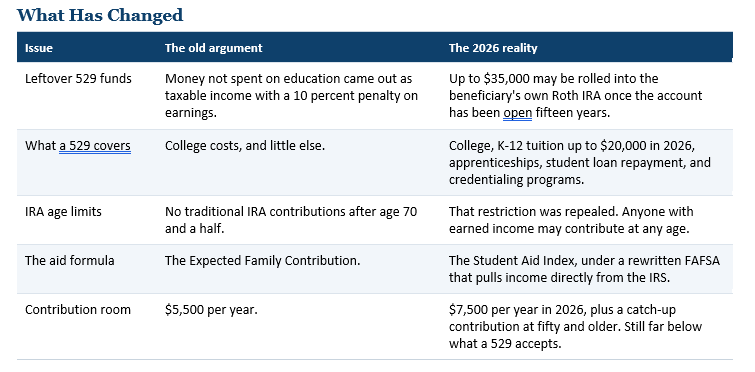
What has changed?
Look at the first two rows together. The flexibility problem that justified the whole strategy is the problem Congress has spent the last several years solving. A 529 plan now funds trade credentials, apprenticeships, student loans, and K-12 costs, and whatever remains can become your child’s Roth IRA. The escape hatch you were building has been installed in the original account.
Where the IRA Still Earns Its Place
We are not dismissing the idea. There are situations where it remains defensible, and you should know them:
- You live in a state with no income tax deduction for 529 contributions, so one of the main advantages of the 529 does not apply to you.
- You are genuinely uncertain whether these dollars are for education or retirement, and you would rather decide later than commit now.
- You are already contributing to a 529 and want a secondary account that the aid formula does not count as an asset.
- You have a working teenager. Sponsorship income, summer wages, and part-time work all qualify your student to fund a Roth IRA in their own name, which is a separate and excellent idea.
What it actually costs you
- Contribution room. The IRA limit is a fraction of what a 529 accepts, and Roth contributions phase out entirely at higher incomes.
- Taxable earnings. The penalty exception for qualified education expenses waives the 10 percent penalty. It does not make the earnings tax free. Before age 59 and a half, withdrawn earnings are ordinary income.
- Aid timing. The account is not reported as an asset, but a distribution can register as income in the year you take it, and the FAFSA looks back two years. A withdrawal timed poorly can reduce the aid it was meant to help pay for.
- Earned income requirements. You must have compensation to contribute, which rules the strategy out for many retirees.
- The real cost. Every dollar you pull from an IRA for tuition is a dollar that will not compound for your retirement. We have said this in each installment of this series, and we will say it again here.
Our Recommendation
Fund the 529 first. It now offers nearly everything the IRA offered in flexibility, plus higher limits, potential state tax benefits, and a purpose-built structure. Fund your retirement accounts for your retirement. And if your teenager is earning money, open a Roth IRA in their name, because that is where the IRA belongs in this conversation.
If you built a college plan around a Roth IRA some years ago, it is worth a second look now. Contact your advisor. We will review what you have, tell you plainly whether the original reasoning still applies, and coordinate with your tax professional on any change.
This information is not intended to be a substitute for specific individualized tax advice. We suggest that you discuss your specific tax issues with a qualified tax advisor.
Disclosure:
Source: IRS: Publication 590-A; Publication 590-B; Publication 970. Public Law 119-21, One Big Beautiful Bill Act, 2025. SECURE Act of 2019. SECURE 2.0 Act of 2022. FAFSA Simplification Act. U.S. Department of Education, Federal Student Aid.
Prior to investing in a 529 Plan investors should consider whether the investor’s or designated beneficiary’s home state offers any state tax or other state benefits such as financial aid, scholarship funds, and protection from creditors that are only available for investments in such state’s qualified tuition program. Withdrawals used for qualified expenses are federally tax free. Tax treatment at the state level may vary. Please consult with your tax advisor before investing.
Investment advice offered through Shepherd Financial Partners, LLC, a registered investment advisor. Registration as an investment advisor does not imply any level of skill or training.
Securities offered through LPL Financial, member FINRA/SIPC. Shepherd Financial Partners and LPL Financial are separate entities.
Additional information, including management fees and expenses, is provided on Shepherd Financial Partners, LLC’s Form ADV Part 2, which is available by request.
This material is for general information only and is not intended to provide specific advice or recommendations for any individual. To determine which strategies or investments may be suitable for you, consult the appropriate qualified professional prior to making a decision.
Tracking #: 1166598