A scholarship rewards what your student has already done. A sponsorship buys what your student can offer. We believe every family should understand that difference before the first check arrives.
Last week, we made the case for funding a 529 plan early. Today, we turn to the money that comes from outside the family. Our message is straightforward: sponsorship money is more available than you think, and it is more complicated than it looks. Both halves of that sentence deserve your attention.
Know what you are expecting
A sponsorship is an exchange. An organization provides money, tuition, or goods, and receives something in return: promotion, a work commitment, or public association with your student’s achievement. A scholarship carries no such expectation. A sponsorship always does.
We emphasize this because the distinction has teeth. Scholarship funds used for tuition and required fees are generally excluded from taxable income. Sponsorship income generally is not. When your student earns four thousand dollars promoting a local business, your student has earned income, with tax and financial aid consequences attached. Learn those consequences before the payment arrives, not after.
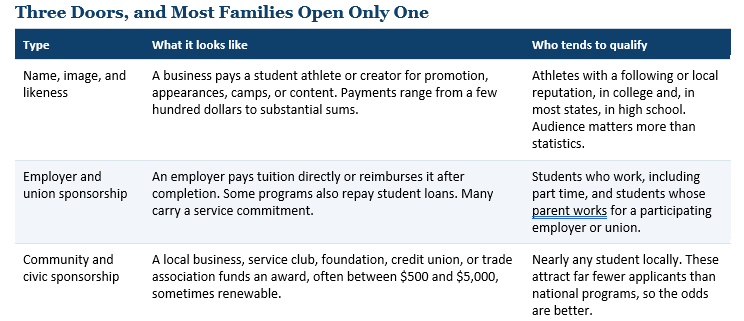
What a 529 Plan Can Fund
We want to draw your attention to the second row. Federal law allows an employer to provide up to $5,250 annually in educational assistance tax free, and the One Big Beautiful Bill Act made that provision permanent while indexing the limit for inflation beginning in 2026. The same benefit may be applied to student loan repayment. This is real money, available without competition, and most families never think to ask for it.
Your student does not need to be a star
Families assume sponsorships belong to elite athletes. We disagree. Three things matter: a defined audience or affiliation, a demonstrated commitment to something specific, and a willingness to ask. The student who coaches youth clinics, runs a small business, competes in a niche sport, or leads a robotics team has something an organization may want to stand behind. And the student whose parent works for a large employer may already qualify for assistance with no competition at all.
Go & Ask
Start local and start specific. Name twenty organizations in your community with a plausible reason to support this particular student. Approach them directly. Do not wait for an application window to open.
Build a one-page profile. State the focus, the accomplishments, the audience, the community involvement, and above all what the sponsor receives in return.
Ask about every affiliation you already hold. Confirm what each parent’s employer offers. Have your student ask any part-time employer. Then check your unions, credit unions, professional associations, faith communities, and alumni groups. These organizations sponsor students routinely and advertise poorly.
Treat every agreement as a contract, because it is one. Read the deliverables, the term, the exclusivity clause, and any service or repayment obligation before anyone signs. For agreements of consequence, involve an attorney.
Prepare before the money arrives
- Confirm the rules that apply to your student. State athletic associations govern high school name, image, and likeness permissions, and they vary meaningfully. College athletes face additional disclosure requirements. Verify before anyone signs, because an unreviewed deal can cost a student eligibility.
- Build the tax infrastructure early. Nothing is withheld from a sponsorship check. A student with net self-employment earnings above four hundred dollars owes self-employment tax and may need to make quarterly estimated payments.
- Anticipate the financial aid effect. The aid formula assesses student income at a higher rate than parent income. A sponsorship can therefore reduce need-based aid. That is not a reason to decline one. It is a reason to see it coming.
- Open a Roth IRA. This is the opportunity families miss. Sponsorship income is earned income, so your student may contribute up to the lesser of that income or the annual limit. For a sixteen year old, those dollars have a fifty-year runway.
- Separate the money and keep records from the first dollar. A dedicated account, with contracts, invoices, and expenses retained, makes reporting straightforward and prevents avoidable work in April.
Our Recommendation
Do not wait for a sponsorship to arrive before you plan for one. In our experience the families who handle this well are the families who understood the tax treatment, the aid consequences, and the contract terms in advance, and who had already asked their employers the obvious question.
So take one step this week. Ask your employer what it offers. If your student already has sponsorship income, or you believe an opportunity is approaching, contact your advisor. We will coordinate with your tax professional, review the planning implications, and help you turn that income into something lasting. The next installment in this series follows later in September.
This information is not intended to be a substitute for specific individualized tax advice. We suggest that you discuss your specific tax issues with a qualified tax advisor.
Disclosure:
Source: Internal Revenue Service: Publication 970, Tax Benefits for Education; Publication 15-B, Employer’s Tax Guide to Fringe Benefits; Topic No. 554, Self-Employment Tax. Public Law 119-21, One Big Beautiful Bill Act, enacted July 4, 2025. U.S. Department of Education, Federal Student Aid.
Prior to investing in a 529 Plan investors should consider whether the investor’s or designated beneficiary’s home state offers any state tax or other state benefits such as financial aid, scholarship funds, and protection from creditors that are only available for investments in such state’s qualified tuition program. Withdrawals used for qualified expenses are federally tax free. Tax treatment at the state level may vary. Please consult with your tax advisor before investing.
Investment advice offered through Shepherd Financial Partners, LLC, a registered investment advisor. Registration as an investment advisor does not imply any level of skill or training.
Securities offered through LPL Financial, member FINRA/SIPC. Shepherd Financial Partners and LPL Financial are separate entities.
Additional information, including management fees and expenses, is provided on Shepherd Financial Partners, LLC’s Form ADV Part 2, which is available by request.
This material is for general information only and is not intended to provide specific advice or recommendations for any individual. To determine which strategies or investments may be suitable for you, consult the appropriate qualified professional prior to making a decision.
Tracking #: 1166515