Executive Summary: Staying Steady and Looking for Opportunity
We are grateful for the trust our clients place in us, and we want to share our perspective on a market that has tested the patience of many investors this fall. The S&P 500 closed November 19 down 8.2% from its October record after six straight losing sessions, the Nasdaq sits roughly 13–14% below its high, and many AI-related stocks, semiconductors in particular, have fallen 30% or more. The news cycle has been equally busy, with a leadership change at NVIDIA, the largest IPO in history from Anthropic, and a steady stream of commentary declaring that the “AI bubble” is bursting.
Our message is one of steady confidence: we see a meaningful, ordinary correction within a healthy market, and we believe disciplined investors are better served looking for opportunities in this volatility than selling into it. Corporate earnings are growing at more than twice their historical rate, the companies at the center of the AI build-out just reported record results, and technology valuations have compressed to their lowest level since March 2020 even as profit forecasts have risen. We take the risks seriously and lay out the strongest case against our view below.
Understanding What Moved the Market
The Nasdaq set a record on October 6. Since then, a series of overlapping worries has pulled markets lower. Investors began questioning whether the enormous sums flowing into AI data centers will earn an adequate return, and how that spending is being financed. Following the midterm elections, markets began pricing in the possibility of tighter regulation of AI and data-center development. On November 5, the Nasdaq fell 5.5%, its worst day since April 2025, while the Philadelphia Semiconductor Index fell more than 12%. On November 12, NVIDIA announced that CEO and co-founder Jensen Huang had resigned amid a personal controversy and a board investigation, naming CFO Colette Kress interim CEO. Most recently, Anthropic completed an $81 billion IPO on November 19. Its shares closed 17% above the offering price, while the broader market fell 2% that day, with more than 90% of S&P 500 stocks declining.
The declines have been concentrated where gains had been largest. Bank of America calculates that the semiconductor index fell 38% from its June 22 peak through November 5, a steeper decline than the 32% average of the last four semiconductor downturns, compressed into roughly half the usual time.

Volatility is the Price of Admission, and We plan for it
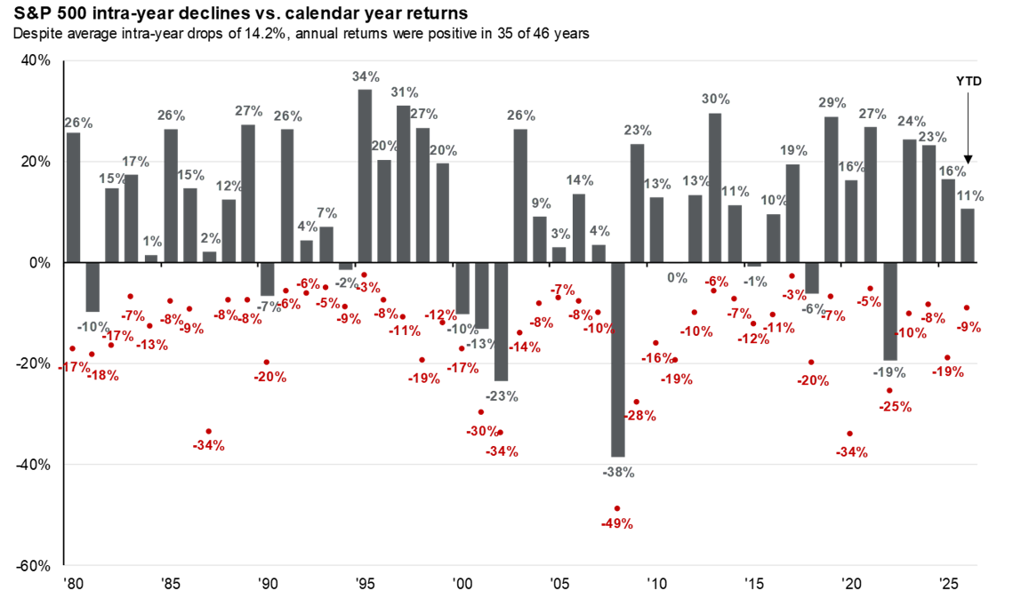
Since 1980, the S&P 500 has experienced an average peak-to-trough decline of about 14% within each calendar year, and it has still finished the year with a positive return roughly three years out of four. Declines of this size are the normal cost of earning equity returns. The chart below illustrates how frequent intra-year corrections can be, and how often annual returns still finish in positive territory.
Source: J.P. Morgan Guide to the Market–data through 9/30/2026
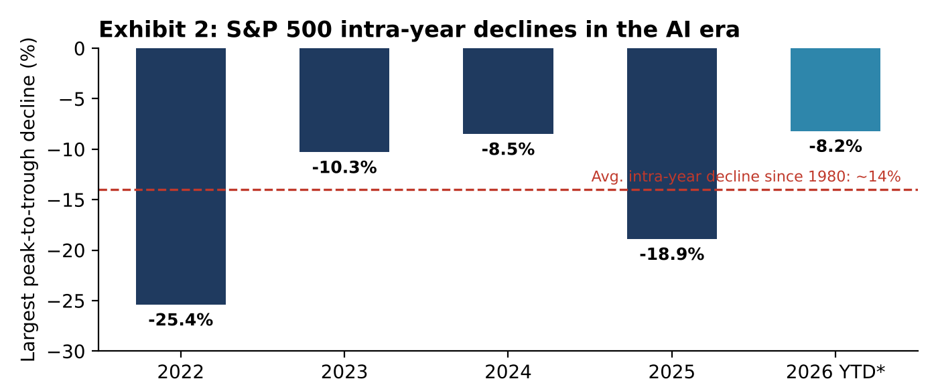
We also recognize that the market has grown choppier since ChatGPT launched in late 2022 and AI became the dominant investment theme. The S&P 500 has seen a sizable drawdown nearly every year in this period, and technology stocks have been even more volatile. The Nasdaq-100 is now in its third correction of 2026 alone: it fell into correction in March, recovered to new highs by June, nearly corrected again in July, and set fresh records in September and October before the current decline. In other words, corrections have become more frequent while the overall trend has strongly moved upward. We expect this pattern to continue as long as a single theme drives such a large share of market value, and we build portfolios with that expectation in mind.
Source: J.P. Morgan Guide to the Markets
Strong Fundamentals Tell the Real Story
Earnings are strong and broad-based
According to FactSet, S&P 500 earnings grew 31.9% year over year in the third quarter, compared with a 10-year average of 12.6%. Revenue grew 14.4%. All eleven sectors reported earnings growth, marking the third consecutive quarter of growth above 25%. Through early November, 84% of reporting companies had beaten estimates, above the 10-year average of 77%. Notably, earnings for the 493 companies outside the “Magnificent 7” have grown faster than the mega-caps this quarter, which suggests the profit cycle rests on a broad base of companies well beyond a handful of AI winners.

NVIDIA: new leadership, the same strong business
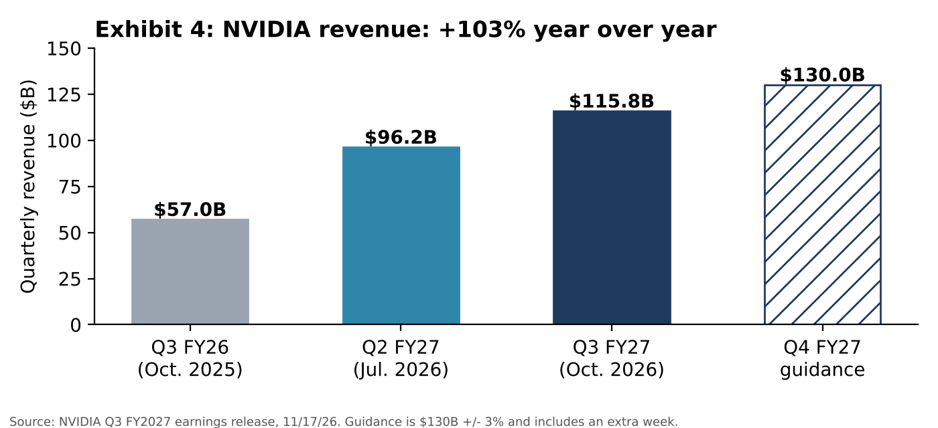
Leadership transitions at iconic companies create genuine uncertainty, and we take that seriously. NVIDIA’s first report under interim leadership, released November 17, was exceptionally strong. Revenue was $115.8 billion, up 103% from a year earlier and well above both the company’s own guidance of $108 billion and analyst expectations. Data center revenue rose 110%. Net income was $65.3 billion, free cash flow was roughly $44 billion for the quarter, and the company returned $28.1 billion to shareholders through buybacks and dividends. Management guided next quarter’s revenue to $130 billion, ahead of the roughly $125 billion analysts expected, while assuming no data center revenue from China. The board has stated that operations, customer commitments, and the product roadmap continue without interruption, and the newest generation of chips is ramping faster than any product in the company’s history.
Demand for AI compute continues to outrun supply
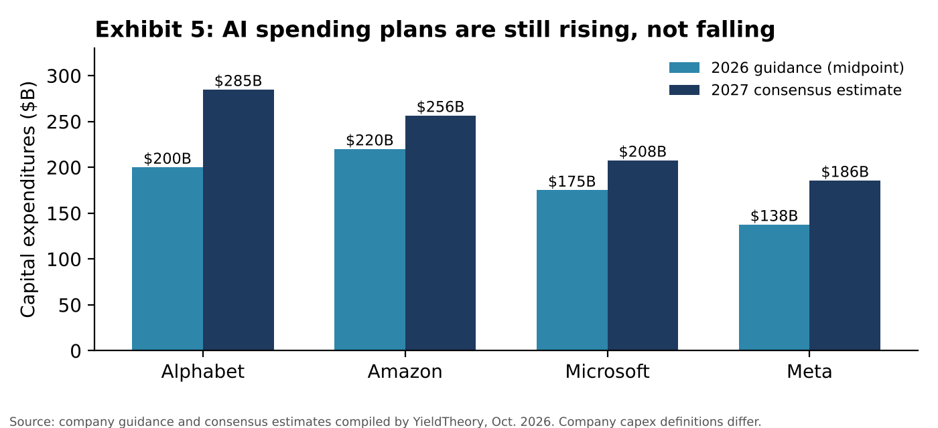
The largest buyers of AI infrastructure continue to report strong demand. In the third quarter, Microsoft’s Azure cloud business grew 48% and Amazon Web Services grew 39%, with AWS reporting a $578 billion contracted backlog and Google Cloud a $561 billion backlog. Amazon indicated that capacity, rather than customer demand, remains its constraint. These companies are planning to spend more: 2026 capital spending guidance across Alphabet, Amazon, Microsoft, and Meta totals roughly $730 billion, and consensus estimates for 2027 are closer to $935 billion.
Balance sheets remain strong, and we are watching one change
NVIDIA holds a fortress balance sheet and generates more cash than it can deploy. Microsoft continues to fund its build-out entirely from operating cash flow and produced about $18.6 billion of free cash flow last quarter. At Alphabet, Amazon, and Meta, the picture has shifted. In the third quarter their capital spending exceeded operating cash flow, and they have turned to the bond market: Amazon raised about $115 billion of long-term debt in the first nine months of the year and Alphabet about $85 billion. These remain among the most profitable and creditworthy companies in the world, and borrowing to fund growth is a standard practice for strong businesses. Still, the shift from self-funded to debt-funded spending sits at the legitimate core of the market’s concern, and it is the single variable we most closely watch.
Rising Earnings and Lower Valuations Create Opportunity
The most striking feature of this selloff is that prices have fallen while profit forecasts have risen. The forward price-to-earnings ratio of the S&P 500 technology sector has dropped to about 16.4x, down from roughly 26.6x at the end of 2025 and its lowest level since the pandemic panic of March 2020. For the first time since 2017, technology stocks trade at a discount to the broader S&P 500, which sits near 17.7x. Over the same period, earnings estimates for the sector have risen by about 17%. Citadel Securities estimated in early November that semiconductor stocks traded at about 13.8x forward earnings, roughly 45% below their January peak.
This environment stands in sharp contrast to the 2000 technology bubble, when valuations were extreme and many of the leading companies earned little or no profit. Today the largest AI spenders rank among the most profitable businesses in history, and the market is paying less for each dollar of their expected earnings than it has in more than six years.

The Economy Continues to Support Growth
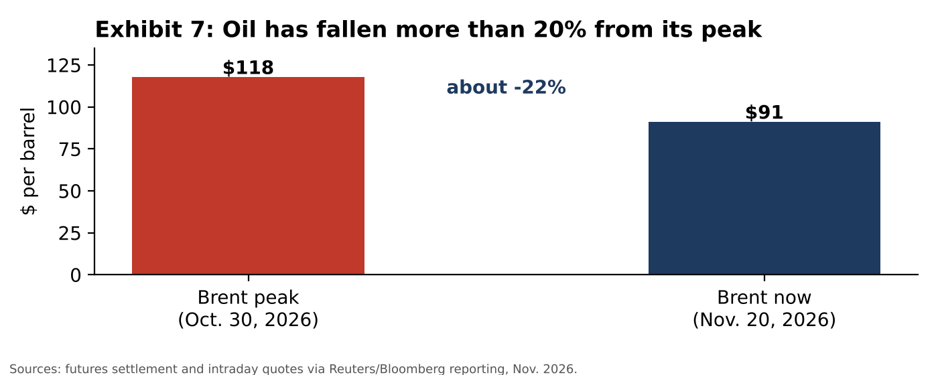
Economic data have consistently come in better than expected. The Citi Economic Surprise Index, which measures data against economists’ forecasts, has been positive in recent months, and the Atlanta Fed’s GDPNow model was tracking fourth-quarter growth of roughly 3.2–3.4% annualized in mid-November. Meanwhile, Brent crude oil has fallen more than 20% from its October 30 peak of about $118 as Middle East export flows have recovered and the International Energy Agency projects a supply surplus. Lower energy prices typically filter into headline inflation with a lag of a few months and act as a tax cut for consumers and businesses.
Weighing the Strongest Case Against Our View
A balanced assessment calls for taking the bearish argument seriously, so we share the strongest version of it here.
- AI spending may be peaking, and semiconductors are cyclical. Capital spending now exceeds operating cash flow at three of the four largest cloud providers, and debt is filling the gap. If returns on AI investment disappoint, these companies could sharply slow spending, and chip-company earnings would fall with them. Bank of America notes that semiconductor stocks typically decline six to nine months ahead of actual sales declines, and low P/E ratios on cyclical stocks can signal a peak in the cycle rather than a bargain. Morgan Stanley has suggested semiconductors could fall a further 10–15% before finding support.
- Interest rates are rising. Inflation remains elevated. Core consumer prices rose 0.3% for a third straight month in October, and futures markets now fully price a Federal Reserve rate hike at the December 9 meeting, with some Fed officials openly discussing a half-point move. St. Louis Fed President Alberto Musalem has suggested as many as four hikes by spring 2027, and the 10-year Treasury yield has been above 5% this fall. Higher rates reduce the present value of future earnings and raise the cost of financing the AI build-out.
- Policy and leadership uncertainty. The post-election regulatory outlook for AI and data centers remains unclear, NVIDIA has yet to name a permanent CEO, and a wave of large AI-related IPOs is adding new supply of stock that competes for investor dollars.
- The oil relief may be temporary. Even after its recent decline, Brent remains up more than 50% for the year because of the conflict in the Middle East, and disruptions around the Strait of Hormuz pose a real upside risk to prices.
Why We See a Healthy Correction Within a Strong Market
Each of these risks is real. Taken individually or together, they remain consistent with a correction, and we see a sustained bear market as the less likely outcome.
On AI spending, the evidence points toward acceleration. Every major buyer reaffirmed or raised 2026 budgets in its most recent report, 2027 plans point higher still, and contracted cloud backlogs measured in the hundreds of billions of dollars give visibility into demand. NVIDIA, the best real-time read on AI demand, just beat its own forecast by $8 billion and guided higher. A cyclical downturn in chips is possible at some point, and semiconductor stocks have already fallen further than in the average past downturn, which means today’s prices reflect a good deal of that risk.
On rates, the reason behind the Fed’s hikes matters. Much of the inflation it is reacting to traces back to supply shocks rather than an overheating consumer: economists at Vanguard and Goldman Sachs point to energy prices, tariffs, and demand tied to the AI build-out. Energy is the most important of these. Although the Fed focuses on core inflation, which excludes food and energy, higher fuel costs gradually seep into core prices through transportation, airfares, shipping, and the cost of producing goods. With Brent now more than 20% below its peak, that pass-through should fade in the months ahead, and a Fed reacting partly to an oil shock has room to slow down as the shock reverses.
Markets are also doing some of the Fed’s work. Higher long-term yields, falling stock prices, and wider risk premiums all slow the economy in the same way a rate hike does. Goldman Sachs’ trading desk noted this week that its U.S. financial conditions basket reached its tightest level of the past year, describing an extraordinarily rapid tightening over roughly two weeks. Fed officials are already divided on how far to go, with some, such as Cleveland’s Beth Hammack and Dallas’ Lorie Logan, favoring a more gradual path. If November inflation data cool, lower oil prices and tighter financial conditions together could mean fewer hikes than the market currently expects.
We also want to be clear about the limits of this argument. Core inflation has run above the Fed’s 2% target for more than five years, which makes policymakers less willing to look through a supply shock than they would otherwise be, and Goldman’s economists still expect another hike in March. Even if the Fed does hike further, it is raising rates because the economy is strong, a very different environment from a recession. With earnings growing at roughly 30%, companies can absorb some multiple compression, and much of that compression has already occurred. For balanced portfolios, higher yields also mean bonds once again pay meaningful income, which cushions overall portfolio volatility.
On headlines, leadership changes and IPO calendars generate short-term noise, while earnings and cash flow drive long-term returns. On both counts, this earnings season has delivered good news.
We would revisit our view if we saw any of the following: major cloud providers cutting capital spending guidance, a meaningful slowdown in cloud revenue growth or backlogs, a sustained widening of corporate credit spreads, or economic data shifting from strength into contraction.
How We Are Putting This Volatility to Work
Corrections can feel uncomfortable, and they are also the moments when discipline pays off. History shows that staying invested through sharp declines preserves the opportunity to participate in the recovery, which often arrives in a handful of strong days that are difficult to time. Rather than reacting to headlines, we are focusing on the following:
- Rebalancing. Where equity allocations have drifted below target, we view this as an opportunity to add at more attractive valuations.
- Tax-loss harvesting. For taxable accounts, we are reviewing positions with unrealized losses that can be harvested to offset current or future gains while maintaining market exposure.
- Thoughtful deployment of cash. For clients with excess cash earmarked for investment, phasing in purchases over the coming months can take advantage of lower prices while managing the risk of further near-term declines.
- Diversification and liquidity. We continue to emphasize diversified portfolios and to hold near-term spending needs in stable assets, so every client keeps the flexibility to choose when to sell.
We invite each of our clients to schedule a brief review with their Shepherd Financial Partners team before year-end, particularly if goals or circumstances have changed. A call or email to our office is all it takes, and we look forward to the conversation.
Disclosures:
This memo is provided for informational purposes only and does not constitute investment, tax, or legal advice or a recommendation to buy or sell any security. Opinions expressed are as of the date of this memo and are subject to change without notice. Forward-looking statements, estimates, and projections are inherently uncertain and actual results may differ materially.
Past performance is not indicative of future results. All investing involves risk, including the possible loss of principal. Diversification and rebalancing do not ensure a profit or protect against loss in declining markets. Indexes are unmanaged and cannot be invested in directly. References to specific companies are for illustrative purposes only and should not be considered a recommendation.
Market data are as of November 19, 2026 unless otherwise noted. Sources include FactSet, LSEG Datastream, Bloomberg, Bank of America Global Research, Citadel Securities, J.P. Morgan Asset Management, the Associated Press, Reuters, company filings and earnings releases, and the U.S. Energy Information Administration. Information obtained from third-party sources is believed to be reliable but has not been independently verified. Shepherd Financial Partners is a registered investment adviser.
Investment advice offered through Shepherd Financial Partners, LLC, a registered investment advisor. Registration as an investment advisor does not imply any level of skill or training.
Securities offered through LPL Financial, member FINRA/SIPC. Shepherd Financial Partners and LPL Financial are separate entities.
Additional information, including management fees and expenses, is provided on Shepherd Financial Partners, LLC’s Form ADV Part 2, which is available by request.
Tracking #: 1212836